Spoiled for Choice: Picking a Platform for Your Online Course
Mary Czekaj on how course creators end up on the wrong platform, what that mistake actually costs, and why good enough beats perfect when choosing where to sell.
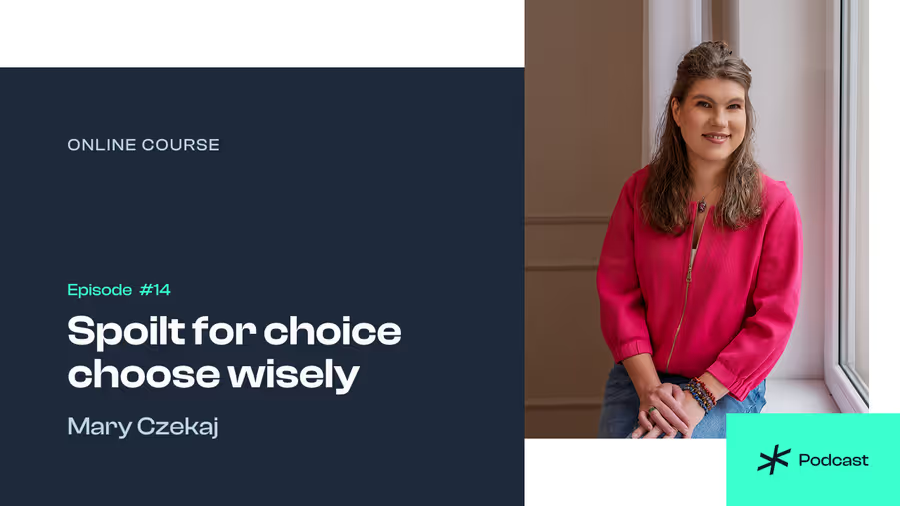
From Food Blogging to Course Infrastructure
Mary Czekaj entered the online business world in 2021 as a food blogger and e-book author, then pivoted to the back end: setting up the technical and strategic machinery other creators need to sell online courses. The work looks simple from the outside, and Mary is careful with the distinction - it is not difficult, but it is dense with details that first-time creators do not know exist. After several years of one-to-one client work she added the other hat, creating and selling her own courses on email marketing. She organises WordCamp Wroclaw, speaks regularly at Polish WordCamps, and will present a talk called “Spoiled for Choice” at CMS Conf this November in Gdynia. In the latest episode of the CMS Conf podcast, host Anja talked with her about the problem the talk is named after: why picking a course platform paralyses so many people, and what the wrong pick costs.
If you are launching a course and want the platform decision, payment setup, and email marketing handled by someone who has done it for dozens of creators, visit Mary’s site at websitekreacje.pl and check her services and courses. Her email marketing courses distil the same systems she builds for clients into something you can apply yourself. It is the fastest way to skip the fifteen-open-tabs phase and get to selling.
Two Ways to Choose Badly
Mary sees two recurring failure modes. The first is inheriting a stack. A creator takes a course from a bigger creator, hears “use this for courses, this for email, this for payments,” and adopts the whole toolchain without asking whether any of it fits their own business. These clients arrive at Mary’s door frustrated, but they are actually in a strong position: they know exactly what annoys them, what is missing, and what they want to avoid. The failed first platform functioned as an expensive requirements-gathering exercise.
The second failure mode is worse because it produces nothing at all: waiting for the perfect solution. Creators research, compare, ask ChatGPT for summaries, and postpone launching until the ideal platform reveals itself. It never does. AI-generated comparisons are only as good as the requirements fed into them, and a creator who has never sold a course does not yet know which features matter. The host added a case from her own client work that shows the same dynamic from the custom-build side: an agency built a bespoke course platform for a client who had no prior course experience, and after eight months of friction the whole thing was replaced with a commercial product, because only then did the client know what she actually needed - in her case, flexible certificate generation for a beauty-industry audience. The sequencing lesson is consistent: start on a ready-made platform, learn your real requirements in production, and only then consider investing in something tailored.
What a Wrong Platform Actually Costs
The costs of a bad pick are concrete. The first is pricing-model drift. Commission-based platforms feel safe at the start because there is no monthly fee, but the commission line grows with revenue, and creators who scale eventually discover they are paying far more than a subscription would cost. Some platforms support both models; many do not, which forces a migration at exactly the moment the business can least afford distraction.
The second cost is operational fragility from over-optimising on price. A WordPress site assembled from free plugins for selling and course delivery works until it does not, and when an error appears in a stack of a dozen plugins, finding it is the hard part. Without a trusted person who already knows the setup, troubleshooting means paying someone to learn your architecture before they can even start fixing it. Mary is blunt that errors happen to everyone; the variable is how much time, money, and stress the recovery consumes.
The third cost is the quietest: student experience. A platform where finding the next lesson is not obvious produces students who stall. Students who stall do not finish, do not leave reviews, do not buy the next course, and do not recommend the creator. A clunky learning interface converts directly into lost repeat revenue, and so does the absence of a support centre when something breaks and the creator is left asking an AI assistant to guess at fifteen possible causes.
Do Online Courses Still Pay Off in the AI Era?
Asked whether selling courses is still viable when anyone can ask AI for knowledge, Mary reframed the question. Plain knowledge was already commoditised by search; AI just compressed the interface. The unresolved problem is the same one Google never solved: people who do not know what they need cannot formulate the right question. A course that merely transfers information competes with AI. A course that diagnoses and solves a specific problem does not, because the buyer could not have specified the problem well enough to prompt their way out of it.
The delivery format is shifting with buyer expectations. Two-hour recorded lectures, whether streamed live or watched later, are university-style artifacts that tired audiences no longer finish. What works, in Mary’s experience, is recorded material as a knowledge base combined with live feedback sessions and Q&A in small groups. That model deliberately trades away the record-once, scale-forever economics of the classic online course, which means pricing and strategy have to change with it. Her advice is to treat this as ongoing market research rather than a one-time format decision: ask your audience what support they want, and then ask again, because the market has changed continuously across the five years she has been in it.
No Best Platform, Only Good Enough
Pressed to name the number-one platform, Mary refused the premise. After five years she has not found one that has everything she wants; there is always a missing email marketing integration or a payment method that requires a second tool. The goal is not perfection but a solution good enough to let the creator focus on strategy and selling. On the Polish market she pointed to a healthy ecosystem: Publigo, built on the WordPress engine and often chosen by people who already know WordPress, which has grown from courses-only into digital products, services, and physical goods; Web2Learn as a differently-shaped alternative; EasyTools, with its deliberately minimal checkout that asks only for the data an online product actually needs; and 1Koszyk in the same spirit. Several of these vendors run public feature-request boards and build what enough users ask for, which Mary reads as a sign of a competitive, improving market. Trust infrastructure matters too: buyers who once accepted a bank transfer arranged over email now expect recognisable payment methods like PayU or Przelewy24, and their absence costs conversions.
A Note for Developers: You Have Two Users
Mary closed with a message aimed at the developer audience coming to CMS Conf. A course platform has two distinct users, and both interfaces have to be easy. The creator logs into a dashboard to configure products, payments, and content; if that is not intuitive, the platform loses the customer. The student logs in to find their course, track expiry, and move through lessons; if that is not obvious, the creator loses their customer. Designing for both at once is the real challenge of this product category, and she recommends beta testing with real users who get free access in exchange for honest, critical feedback. Testers whose feedback visibly lands become advocates.
Hear the Full Framework in Gdynia
The podcast conversation is a preview; the full platform-selection framework arrives with Mary’s “Spoiled for Choice” talk at CMS Conf this November in Gdynia. If you are a course creator, or a developer building for them, this is the rare session that covers the decision from both the strategic and the technical side, and tickets are limited, so buy yours at CMSConf.com before the early-bird pool runs out. If your launch cannot wait until November, go to websitekreacje.pl now, check Mary’s email marketing courses, or book her to set up the selling and delivery stack for you. The difference between researching platforms and selling on one is usually a single good decision, and both the talk and Mary’s work exist to help you make it.
Tags
Keep Reading
SEO After the CMS Absorbed the Technical Layer
Aleksandra Kołodziejska of Top Online on GEO, the 90/10 content split, and why real experience became the strongest ranking signal for local business sites.
What Clients Say They Want vs What They Actually Need
Piotr Cezary Wojciechowski of Softwareness on client discovery as an architectural decision: separating stated wants from real needs before any CMS is chosen.
How to Avoid the Most Common CMS Website Marketing Mistakes
Paulina Grębowiec breaks down the marketing mistakes that derail CMS websites - and shows why most of them are decided long before any code is written.