Communication Intelligence and the Hidden Cost of Tech Leadership
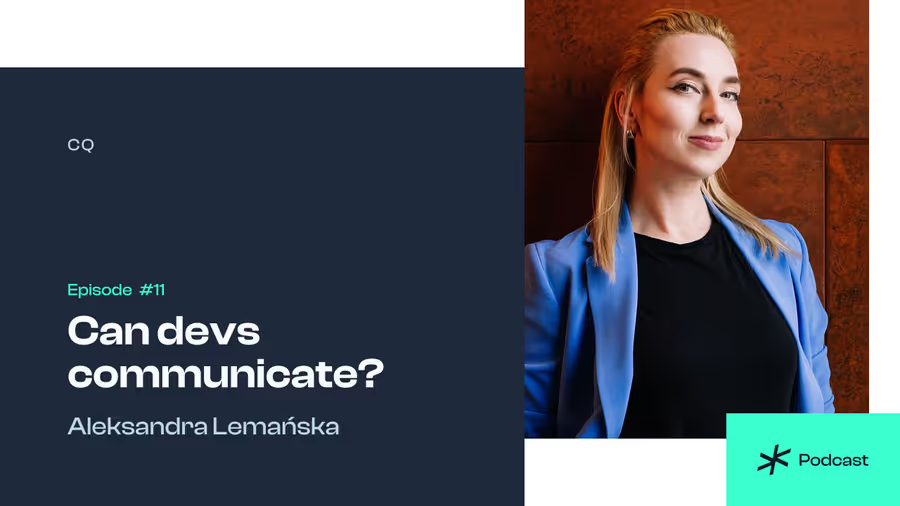
Aleksandra Lemańska on CQ, the communication debt draining engineering teams, and turning soft skills into an algorithm leaders can actually run.
A Strategic Skill Mislabelled as a Soft One
Most engineering organisations treat communication as a soft skill - something nice to have, sitting somewhere below system design and shipping velocity on the list of things that matter. Aleksandra Lemańska, founder of LemanSkills and creator of the CQ Leadership Method, argues that this classification is the root error. Communication, in her framing, is not soft. It is a strategic skill: the differentiator that decides whether well-designed code becomes a product people actually use, or whether it dissolves into misunderstanding, rework, and conflict. CQ - communication intelligence - is the structure she builds around that skill, the same way IQ and emotional intelligence describe other measurable capacities.
If you lead a team and recognise the pattern - brilliant engineers who ship great code but stall the moment they have to align with a client, a manager, or each other - Aleksandra’s work is built for exactly that gap. The CQ Leadership Method, her Leman Tech Leadership Podcast (over 160 episodes deep), and her upcoming book give tech leaders a concrete, repeatable system for diagnosing and fixing communication breakdowns instead of treating them as personality clashes. Explore the full programme at LemanSkills or start with the free CQ Leadership Method masterclass - the framework is designed to be used on Monday morning, not admired in theory.
Communication Debt Is a Number, Not a Feeling
The central concept in Aleksandra’s work is communication debt: the measurable cost a poor communication level imposes on an organisation. Like technical debt, it compounds, and the larger the organisation, the larger the balance. She has built a calculator around it, drawing on her own research and the broader literature, and the components are concrete rather than impressionistic.
The first input is wasted time. Somewhere between 7 and 17 hours per employee, per week, disappears into misunderstandings, unnecessary meetings, and the Slack-and-email ping-pong that produces no value - up to 40% of a person’s working time. Each of those hours carries an hourly cost. The second input is engagement: disengaged people deliver slower and at lower quality, and fall more easily into the same conflicts that drain the first bucket. The third is health - there is a direct correlation between sustained poor communication and burnout, and burnout converts directly into sick leave and missed deadlines. The fourth, and largest single line item, is retention. Replacing someone who quits over a dysfunctional communication environment costs between 50% and 200% of their annual salary. Summed across a team, these are not abstractions. They are a real number on the organisation’s books that almost nobody is tracking.
Leaders Are the Source of the Pattern
Aleksandra is direct about where the debt originates. Direct reports, she says, behave like children: they observe their leader, map the behaviours, and repeat them. A CTO or team lead who tells their people to communicate better - buy them the books, the workshops, the time - while exempting themselves from the same work is running what she calls fake leadership. The instruction does not match the behaviour, and the team reads the behaviour.
The pattern she encounters repeatedly is the leader who says “I want my people to be better at this” and, when asked what they themselves are doing about it, answers “I don’t have time - it’s not a priority.” That answer is the problem stated out loud. Without a leader modelling the skill, the directive is not authentic, and the team will not adopt it. Aleksandra frames the stakes in terms of the current moment: as AI reshapes what technical expertise is worth, the social and strategic skills - a strong CQ muscle - are increasingly what keeps a leader competitive and employable. This applies even to freelancers with no team, who are still leaders of their own client relationships.
The Process Communication Model: Six Types as an Algorithm
The CQ Method rests on the Process Communication Model (PCM), a framework developed from Taibi Kahler’s work with NASA - built originally to assemble astronaut crews who could survive the extreme pressure of space without the option of walking away from a conflict. Five decades and roughly 1.8 million profiles later, it describes personality as six layers, each with its own strengths, preferences, and language patterns. Crucially, everyone contains all six; what differs is the order and how readily a person can access each one. There are 720 possible arrangements.
The six types map to distinct languages. The first speaks data - facts, logic, processes, bullet points, straight to the point. The second speaks opinions and values, guards the rules and procedures, and asks what value a thing brings. The third speaks emotions, builds relationships, and tends the atmosphere of a room. The fourth speaks action - do it now, no monotony, constant change. The fifth speaks reactions - playful, creative, energised by people and spontaneity. The sixth speaks reflections - solution-driven, deep, quiet, generating options internally and sharing them only when asked. The failure mode is universal: people communicate in the language they themselves prefer. When a data-speaker and an emotion-speaker talk, they are, neurologically, using the same brain machinery as someone speaking a foreign language - which is why the conflict feels like dislike when it is really untranslated signal.
Six Communication APIs in Every Engineering Team
Aleksandra’s most engineering-native framing is to call these types APIs. In most tech teams, two dominate: the data API and the reflection API - both highly rational, both working primarily through the brain, and both prone to dismissing social skills as unimportant precisely because they do not see them as algorithms. Naming them as APIs reframes the whole problem. Communication becomes a process you can run: observe the repetitive wording in someone’s emails or messages, form a hypothesis about their base type, tailor your own language - word choice, tone, even facial expression - to match, then watch how they respond. If they answer the way you intended, the communication process worked. If not, you adjust the inputs and run it again.
This is the part she says lands hardest for technical audiences: communication, long sold to them as touchy-feely and uncomfortable, turns out to be data-driven and framework-based. You gather quantitative and qualitative signals, form a hypothesis, test it, and iterate. At CMS Conf her session will be deliberately practical - a self-mapping exercise first, then case studies built on real email and Slack messages, training the recognition step that is the foundation of the whole skill. Attendees are encouraged to bring their own difficult-conversation examples; the framework answers not just “why is this person hard to reach” but “what do I do about it.”
Where to Go Deeper
Communication intelligence is not a personality quiz that hands you a label and stops. It is a working tool for the situations that actually cost teams money - the angry client, the tight deadline, the stakeholder you keep talking past - and through LemanSkills, Aleksandra Lemańska has spent her career turning it into something a tech leader can run like any other system. To go deeper before the event, start with the Leman Tech Leadership Podcast, explore the CQ Leadership Method at LemanSkills, and follow her on LinkedIn, where she publishes daily. Then catch her talk in person: CMS Conf happens for the first time this year, she will be present for the full event, and she is offering free one-to-one consulting on your own communication cases throughout. Secure your ticket now at cmsconf.com and come ready to map yourself first - bring something to write on, and leave the phone in your pocket.
Tags
Keep Reading
SEO After the CMS Absorbed the Technical Layer
Aleksandra Kołodziejska of Top Online on GEO, the 90/10 content split, and why real experience became the strongest ranking signal for local business sites.
Spoiled for Choice: Picking a Platform for Your Online Course
Mary Czekaj on how course creators end up on the wrong platform, what that mistake actually costs, and why good enough beats perfect when choosing where to sell.
What Clients Say They Want vs What They Actually Need
Piotr Cezary Wojciechowski of Softwareness on client discovery as an architectural decision: separating stated wants from real needs before any CMS is chosen.