First time in Tricity? A quick guide for international guests — culture, safety, and helpful apps
Decision made! You’re coming to Poland in November to join us in Gdynia for CMS Conf. What now?
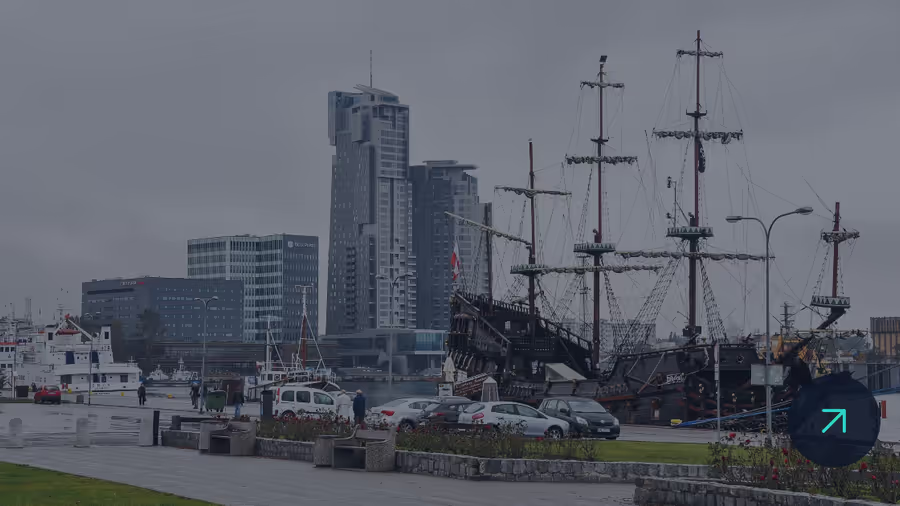
How do you plan your trip around Poland and get around the Tricity area so everything goes smoothly? What can you expect, what might surprise you, and what can support you along the way?
Welcome to a quick conference guide for our international guests. Here you’ll find recommended apps, basic cultural tips, and a few practical notes about safety in Poland.
About Tricity and practical logistics
Tricity (Gdańsk–Sopot–Gdynia) works as one connected area — three cities linked by the SKM urban rail line, the sea, and a great food scene. If you’re flying in for CMS Conf (or simply visiting the region for the first time), this is the practical “minimum” that will help you feel confident from day one.
From our recent post you already know how to get here — and if you haven’t read it yet, we recommend: “How to Reach CMS Conf 2026”.
Currency and payments
Poland uses the Polish złoty (PLN). Payment cards are accepted almost everywhere — including public transport and many taxis. Still, having a little cash can be useful for small places or vending machines. ATMs are widely available; avoid machines with suspiciously high fees and always choose to be charged in PLN (not your card currency) if the terminal asks about DCC.
If you prefer paying by phone, Apple Pay / Google Pay are widely accepted. If someone suggests paying with BLIK, you may not have it — it’s very popular in Poland but not common abroad. In that case, cash will do the job.
Sunday shopping (non-trading Sunday) — 15 November 2026
One small thing that can surprise visitors: many Sundays in Poland are non-trading Sundays, which means most large supermarkets, shopping malls, and many retail stores are closed. In 2026, shopping Sundays fall on selected dates — none of them are in November.
Sunday, 15 November 2026 is a non-trading Sunday, so expect most big stores and malls to be closed. Don’t worry — small convenience stores (for example, Żabka), some local shops, and shops at petrol stations are typically open, and most restaurants/cafés operate as usual.
If you need groceries or essentials, it’s best to do a quick shop on Saturday, 14 November (or earlier) to avoid last-minute stress.
Getting around Tricity
The simplest combo is SKM (urban rail) + walking. SKM runs frequently and connects the city centers in just a few dozen minutes. For shorter trips within a city, buses and trolleybuses are useful (especially in Gdynia). You can buy tickets in ticket machines, kiosks, and in apps.
Apps worth having
- Jakdojade: public transport navigation and (in many cities) ticket purchases.
- KOLEO: train timetables and tickets for selected operators.
- Google Maps: works very well with public transport.
Safety and common sense
Tricity is generally safe, and Poland is considered a country with relatively low crime rates compared to many parts of Europe. In travel safety reports, Poland is often described as one of the safer destinations in the region.
As in any tourist area, basic common sense goes a long way: watch out for pickpockets in crowded places (stations, promenades, events), stick to well-lit routes at night, and use official transport services. The emergency number across the EU is 112, and for urgent medical emergencies you can also call 999.
Rules and everyday culture in Poland
You’ll likely feel comfortable in Poland quickly — especially in Tricity, which is open and used to international visitors. Still, it’s worth knowing a few local habits and simple rules to avoid misunderstandings, stress, or an unnecessary fine.
Below are practical tips on everyday etiquette, tipping, Sunday shopping rules, what not to do in public spaces, and what to watch out for in public transport.
Fines and penalties: what to watch out for in Poland
Poland is safe and quite “orderly,” but a few basic rules are worth knowing — these small things are exactly what tourists most often get fined for.
The most common case is public transport and trains: no valid ticket, the wrong ticket, or missing proof of a discount can result in an additional fee. Ticket inspections can be frequent, especially in larger cities.
Another classic is crossing on a red light or crossing the road in an unauthorized place. Even if the street looks empty, these violations may be penalized.
In public spaces, pay attention to alcohol: drinking in the street, parks, or on public transport is usually prohibited (exceptions may exist in designated areas). The same goes for smoking — many places have clearly marked bans, including public transport stops and near building entrances.
Finally, there are “public order” issues: littering, disturbing the peace, vandalism, or damaging green areas can lead to fines — often higher than people expect.
If you plan to drive, the typical topics apply: illegal parking, speeding, holding a phone while driving, and not wearing seatbelts. Parking enforcement can be regular in city centers and around stations.
Also remember phones: in Poland fines may apply not only to drivers for holding a phone while driving, but also to pedestrians for using a phone while stepping onto or crossing a pedestrian crossing, if it distracts you and limits your ability to observe traffic.
Useful addresses for international visitors in Tricity
Conference venue
Pomorski Park Naukowo-Technologiczny (PPNT), Gdynia — al. Zwycięstwa 96/98, 81-451 Gdynia
Airport
Gdańsk Airport (GDN) — ul. Słowackiego 200, 80-298 Gdańsk
Main train stations
Gdynia Główna — Plac Konstytucji 1, 81-354 Gdynia
Gdańsk Główny — Podwale Grodzkie 2, 80-895 Gdańsk
Tourist information
Tourist Information Gdynia — ul. 10 Lutego 24, 81-364 Gdynia
Police (if you need to report something)
Gdynia City Police Headquarters — ul. Portowa 15, 81-350 Gdynia
Medical help (ER / hospital)
St. Vincent de Paul Hospital (Szpitale Pomorskie), Gdynia — ul. Wójta Radtkego 1, 81-348 Gdynia
Need support during your stay in Poland?
If this is your first time in Poland — don’t worry, you’re not alone. CMS Conf is not only talks and workshops, but also a community of people who genuinely enjoy talking and helping each other. So if you need something on site, you don’t have to rely only on organizers or volunteers. Feel free to ask other conference participants as well.
Polish attendees are often happy to help with practical things: the best way to get somewhere, where to eat, how to buy a ticket, how SKM works, or how to handle those “local details” that can be surprising at first. And one more thing: many Poles speak English really well… they just sometimes claim otherwise. 😉
If you need help, you can start with something simple:
“Hi! It’s my first/second/third… time in Poland — could you help me with…?”
Tags
Keep Reading
SEO After the CMS Absorbed the Technical Layer
Aleksandra Kołodziejska of Top Online on GEO, the 90/10 content split, and why real experience became the strongest ranking signal for local business sites.

Spoiled for Choice: Picking a Platform for Your Online Course
Mary Czekaj on how course creators end up on the wrong platform, what that mistake actually costs, and why good enough beats perfect when choosing where to sell.
What Clients Say They Want vs What They Actually Need
Piotr Cezary Wojciechowski of Softwareness on client discovery as an architectural decision: separating stated wants from real needs before any CMS is chosen.