Personal Websites for AI Visibility
Daniel Stanica, founder of Competico, on why personal brands need an owned website in 2026 — and how to structure it so AI search engines actually cite it.
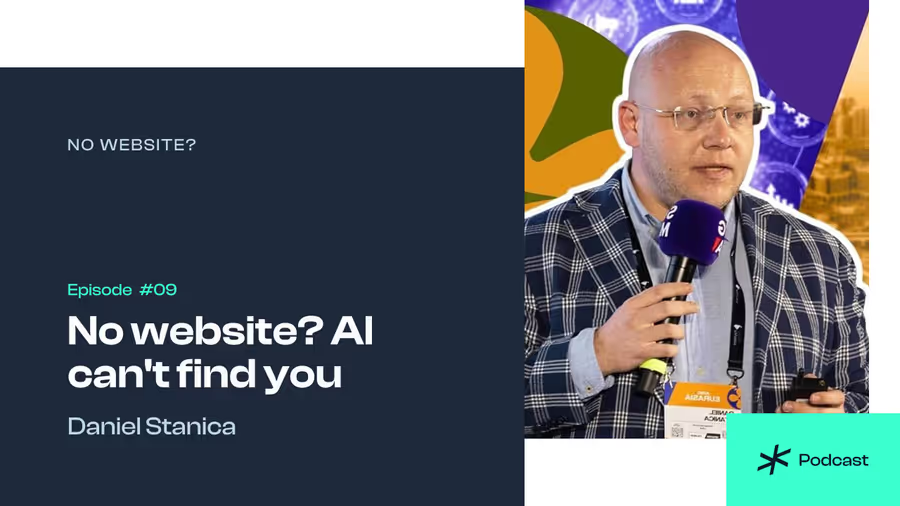
A Twenty-Year Holdout Finally Buys a Domain
For two decades Daniel Stanica advised every client he had to launch a website, and for two decades he refused to launch his own. He ranked other people’s sites, ran agencies, spoke at CloudFest and WordCamp Europe, built communities on LinkedIn and Facebook, and never needed a domain of his own. In May 2026 that changed. The reason is not nostalgia or vanity. It is that the system that decides whether a person is “discoverable” has quietly switched its source of truth — from human researchers paging through Google results to large language models assembling answers from whatever they can crawl, parse, and trust.
If you advise founders, consult on visibility, or sell your name as part of the offer, Competico is worth a look. Daniel and his team build AI-visibility frameworks for digital businesses adapting to LLM-driven search — the same playbook he applied to his own launch. If your brand is invisible inside ChatGPT or Gemini results today, that is the gap they specialise in closing.
Why an Owned Website Becomes Load-Bearing in AI Search
The architectural shift Daniel describes is easy to miss because the surface stays familiar — you still type a query and read an answer. What changes is the path between the question and the answer. Where a person used to spend twenty or thirty minutes assembling context about a doctor, a consultant, or a vendor, an LLM now does it in seconds, drawing from a set of sources it has decided to trust. A LinkedIn profile is part of that set. So is a Facebook page, a YouTube transcript, a podcast description. A personal website is not just one more source — it is the only source the subject actually controls.
This control matters more than it used to. AI systems do not weigh all sources equally — they prefer crawlable, structured, durable references over walled or ephemeral ones. Instagram was uncrawlable for AI engines until very recently; large accounts there were effectively dark to LLMs. A WhatsApp community is invisible by design. A LinkedIn post may rank well today and disappear from the index tomorrow. The website remains the one node in the graph that the subject can shape, archive, and keep online indefinitely. Without it, the LLM’s answer about you is assembled entirely from sources someone else decided to publish.
Structured Data is the Interface to AI Readers
A website that looks good to humans is not automatically legible to an LLM. Daniel is direct about this: schema markup is no longer a nice-to-have, it is the contract through which a site declares what it is. Person schema, Organization schema, Review, FAQ, Article — each one is a structured statement the crawler can parse without inference. Without schema, the AI has to guess what a page is about. With schema, the page tells it explicitly.
The same logic applies to heading hierarchy, lists, and comparison tables. AI readers reward content that is already chunked into semantic units. A wall of prose forces the model to do the segmentation work itself, and the result is less reliable retrieval. A page with a clear H1, H2-driven sections, bullet lists where they belong, and tables for actual comparisons is parsed faster and cited more often. None of this is new — it is the same structured-content discipline good SEO has always asked for. What is new is that the cost of getting it wrong is no longer just lower ranking. It is being absent from the answer entirely.
The third leg of the structure is external. AI search treats off-site citations the way classical SEO treats backlinks: a vote of confidence that the entity exists and is worth recommending. Reviews on Trustpilot, mentions in trade press, podcast appearances, conference talks — these are the corroboration the LLM needs before it will surface you as an authority. The personal website becomes the canonical hub the citations point back to.
Social Platforms as Cache, Not Source of Truth
The architectural mistake most personal brands make is treating a social platform as their primary storage. Daniel has seen accounts with forty or fifty thousand followers disappear overnight — sometimes deplatformed for a content-policy edge case, sometimes hacked, sometimes simply lost to a coordinated mass-reporting campaign. The follower graph belongs to the platform, not to the person. When the platform decides to remove or de-rank the account, the audience is unreachable through any channel the creator controls.
The systems-level response is the same one any architect would apply: the platform is a cache; the website plus a newsletter list is the source of truth. Daniel’s recommendation is to treat social media as an amplifier — a distribution layer that points back to owned infrastructure — not as the primary store. A website holds the durable content. A newsletter holds the subscriber relationship. A community channel (WhatsApp, Telegram, Discord) provides a second line of contact if the social account is lost. Each layer is replaceable; together they survive the failure of any single platform.
Impersonation adds another dimension. Spoofing a personal website requires a domain takeover and a hosting compromise; spoofing an Instagram handle requires only a similar username. The website is harder to fake, which makes it the natural canonical reference when the AI is deciding which of several conflicting “Daniel Stanica” profiles to trust.
Choosing the CMS: When the Default Stops Being Default
For Daniel, WordPress had been the default for fifteen years. For the launch of danielstanica.com, he deliberately picked something else — eM-Dash, a young CMS built on Cloudflare Workers, TypeScript end-to-end, with content types defined in the admin without plugin scaffolding and plugins running sandboxed with explicit capability grants. He is honest about the state of the project: version 0.8, small community, caching still in development, and not the choice he would recommend to a non-technical owner today. But the reasoning is worth the read. He wanted native MCP support and a stack already shaped around AI tooling, because AI is no longer just a consumer of the site’s output — it is part of his authoring workflow, his review loop, and his design process.
The decision is not “eM-Dash is better than WordPress.” It is that the default CMS choice is no longer automatic. Different stacks make different trade-offs for AI-era publishing: how easily they expose structured data, how cleanly they integrate with model context protocols, how the plugin security model behaves when you are letting AI assistants touch the codebase. The right question is no longer “which CMS is most popular.” It is “which CMS makes my content most legible to the systems that will summarise it.”
Where to Start This Week
If you do not have a personal website yet, Daniel’s actionable step is small enough to ship in an evening: register the domain with your name on it. Even if you redirect it to LinkedIn for the next six months, the name is yours. The cost of waiting is that someone else takes it, and the price to recover it later runs into the thousands. After the domain is registered, the website itself can grow incrementally — a one-page profile, then articles, then archived podcast appearances, then events. The LLMs pick it up over time. The trajectory accumulates.
The biggest mistake Daniel sees is the opposite pattern: launch a site, ignore it for two years, and wonder why it never surfaces in AI answers. Personal-brand sites need ongoing input — new posts, recorded talks, event listings, articles. Each addition is a fresh signal to the crawlers and another anchor for citations. A static one-page site with no updates and no schema is not much better than no site at all.
The Close
If you sell consulting, advise founders, build in public, or compete for visibility in any field where your name is the product, Competico is the team to talk to. Daniel and his colleagues build AI-visibility frameworks tailored to the way LLMs actually crawl, weigh, and cite — not the way SEO worked five years ago. The window to get ahead of competitors who have not noticed the shift is open right now, and it will not stay open long. Book a consultation, audit your current AI presence, or just read what Competico is publishing about the AI-visibility stack. The brands that treat 2026 as the year they architect for LLM citation will outrun the ones still optimising for ten blue links.
Tags
Keep Reading
SEO After the CMS Absorbed the Technical Layer
Aleksandra Kołodziejska of Top Online on GEO, the 90/10 content split, and why real experience became the strongest ranking signal for local business sites.
Spoiled for Choice: Picking a Platform for Your Online Course
Mary Czekaj on how course creators end up on the wrong platform, what that mistake actually costs, and why good enough beats perfect when choosing where to sell.
What Clients Say They Want vs What They Actually Need
Piotr Cezary Wojciechowski of Softwareness on client discovery as an architectural decision: separating stated wants from real needs before any CMS is chosen.