Sales Strategy in the AI Era
Aga Slipczuk on what counts as an actual sales strategy in 2026, why AI accelerates the funnel without replacing it, and the foundational work most businesses skip.
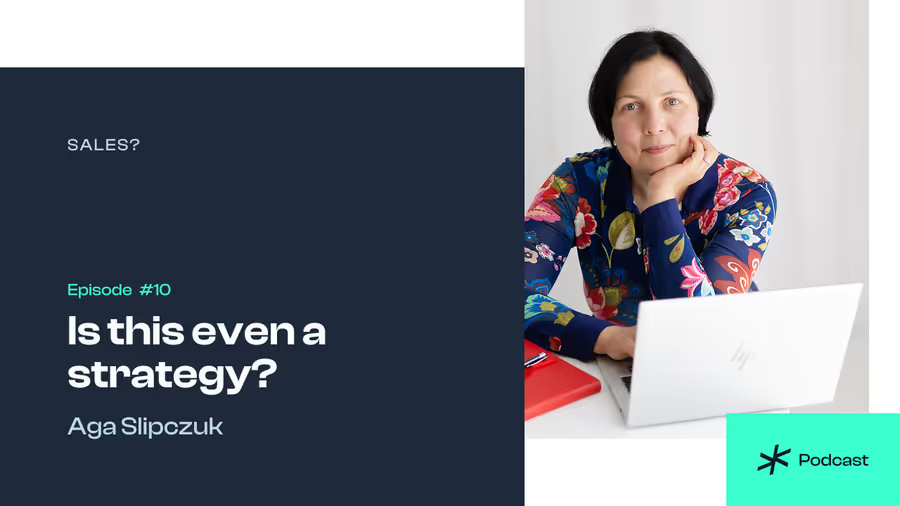
A Twenty-Year Hotel Sales Career and a Decision to Start Over
After more than twenty years in hospitality sales — Marriott, Starwood, Radisson, Puro — and over fifteen years running corporate sales teams (including the national sales office for Marriott Poland), Aga Slipczuk launched her own advisory and training firm in September 2025. The pivot was not a slow career drift. A change in personal circumstances meant the corporate-office model no longer fit the life she wanted to live, and she rebuilt her work around the one thing she had spent two decades doing well: helping organisations build sales strategies that actually function in production.
If you are an owner, founder, or sales lead trying to figure out whether what you have is a strategy or a hopeful marketing plan, agaslipczuk.com is the place to look. Aga’s training programmes, audits, and one-to-one work cover sales strategy design, budget construction, customer-journey architecture, and the AI-in-sales tooling she actively tests. Book a session, take one of the courses, or follow her sales work on Instagram as agaslipczuk_sales — the entire point is to replace gut-feel sales with a process you can measure, repeat, and trust.
A Strategy Needs Twelve Months Before It Tells You Anything
The most common failure pattern Aga sees in small and mid-size businesses is impatience. A founder launches something they call a strategy, runs it for two or three weeks, decides it is not working, and pivots. Then they do the same thing again. The architectural problem is not the strategy itself — it is the missing measurement horizon. A real sales strategy is designed for a twelve-month cycle, against a real budget, with goals defined up front and checkpoints along the way. Anything shorter is not a strategy; it is a guess that has not been given time to fail or succeed.
The minimum useful evaluation window is six months. Twelve is better. Inside that window the work is to check, weekly and monthly, where reality is diverging from plan, then ask why — and shift resources, not the whole strategy, in response. The discipline Aga describes is closer to operations than to inspiration: design something measurable, ship it, watch it run, intervene narrowly. “Three quick strategies that will transform your business overnight” — the LinkedIn-flavoured promise — is, in her words, bullshit. Nothing meaningful in sales compounds in less than several quarters.
Sales Is Not Marketing — and the Order Matters
The second structural mistake Aga keeps running into is the conflation of sales and marketing. Both matter, both run in parallel, but they are different fields with different artefacts. Marketing without a sales foundation has nothing real to communicate: no defined product, no segmented customer base, no concrete offer. Owners promote an idea that has not been built yet — a reel here, a post there, a vague launch — and then wonder why the funnel produces nothing.
Sales comes first because it produces the structured inputs marketing needs: the product definition, the client base, the value proposition, the price tier, the segmentation. Marketing then amplifies that structure into demand. A team that inverts the order — marketing first, sales as an afterthought — is broadcasting against a void. The flag waves. The pipeline stays empty.
What AI Actually Changes About the Sales Funnel
Aga is unambiguous about AI’s role: it accelerates the funnel, but it does not replace strategy. The classical funnel — awareness, interest, decision, action, loyalty — was linear and slow. AI bends it into something dynamic and far more personalised. Customer journeys that used to take weeks to assemble from cold calls, door-to-door visits, and Excel-driven follow-ups now compress into hours, sometimes minutes, with real-time personalisation built in.
The architectural shift is from mass communication to hyper-personalisation. A retail customer no longer waits days for a recommendation; they get one within seconds of landing on a page. An AI changing room renders an outfit before they have decided whether to walk into a physical store. A history that used to require weeks of behavioural data is assembled in a single session and used to shape the next interaction immediately. This is a different funnel — same five conceptual stages, dramatically different latency and resolution.
The risk in this shift is the same risk Aga sees everywhere: people add the AI layer to a sales process that was never properly designed. The funnel cannot personalise what was never segmented. The CRM cannot automate follow-ups against a database that does not exist. The gadgets work, but they sit on no foundation, and the structure collapses under its own weight. AI is force multiplication, not foundation laying.
CRM, Automation, and Tools That Work While You Sleep
The tooling Aga recommends is unglamorous and high-leverage. A well-configured CRM is, in her phrase, “pure gold” — it saves the time the old Excel-and-spreadsheet workflow consumed, keeps the customer journey consistent across touchpoints, and feeds the personalisation layer with real data. Administrative tools like Asana keep the operational layer running. An email automation platform like MailerLite handles the follow-up cadence that no salesperson has time to maintain manually.
The pattern underneath the tool list is that automation buys back time which is then reinvested in the part of sales that cannot be automated: the human relationship. AI handles segmentation, scheduling, sequencing, and surface personalisation. The salesperson handles the moments where a customer needs to feel that someone on the other end actually listened. Aga’s view is that this human factor is innate, not teachable — you either enjoy people and curiosity about their needs, or you do not — and AI exists to free more of a salesperson’s day for exactly that. The tools work while you sleep so that, awake, you can do the part nothing else can do.
What a Strategic Plan Actually Contains
When a new client engages Aga, the first deliverable is not a tactic. It is a strategic plan, and it has fixed components: business plan analysis, market analysis, segmentation, a top-accounts list (existing or aspirational), and a calendar of events, deadlines, and seasonal patterns that will move the budget month-to-month. Each component then expands. Business plan analysis means comparing prior-year results against next-year assumptions and writing down three concrete strategies to be pursued. Market analysis means describing current conditions, identifying operational challenges, estimating expected market share, and mapping competitors — including ones not yet in the market.
This is the work most owners skip. It is not exciting, it does not produce a shareable graphic, and it takes longer than a weekend. But it is the foundation that turns a “great idea” into a measurable process, and without it the sales budget, the CRM configuration, and the marketing spend are all running blind. Aga’s diagnostic is brutal and useful: when someone tells her they have a sales strategy, she asks what is in it. Most of the time, the answer is a marketing plan with the wrong label.
One Thing to Do This Week
If you run a business, lead a sales team, or sell anything to anyone, Aga’s actionable step for the next seven days is the same diagnostic she runs with new clients: check whether what you have is a strategy or a marketing plan. Write down the components. If there is no twelve-month budget, no segmentation, no top-accounts list, no event calendar — there is no strategy yet. There is a starting point.
If that diagnostic produces an honest answer you do not like, agaslipczuk.com is the next click. Aga’s courses walk through sales budget construction, customer-journey design, and the working integration of AI tools into a real sales process — not the influencer-flavoured version, the operational one. Book a session, sign up for a course, or follow her practical sales work on Instagram (agaslipczuk_sales). Businesses that get the foundation right in 2026 will pull away from competitors still chasing overnight wins, and the time to start is before the next twelve-month budget cycle begins, not after it has already closed.
Tags
Keep Reading
SEO After the CMS Absorbed the Technical Layer
Aleksandra Kołodziejska of Top Online on GEO, the 90/10 content split, and why real experience became the strongest ranking signal for local business sites.
Spoiled for Choice: Picking a Platform for Your Online Course
Mary Czekaj on how course creators end up on the wrong platform, what that mistake actually costs, and why good enough beats perfect when choosing where to sell.
What Clients Say They Want vs What They Actually Need
Piotr Cezary Wojciechowski of Softwareness on client discovery as an architectural decision: separating stated wants from real needs before any CMS is chosen.