Is WordPress Still the Right Business CMS in 2026?
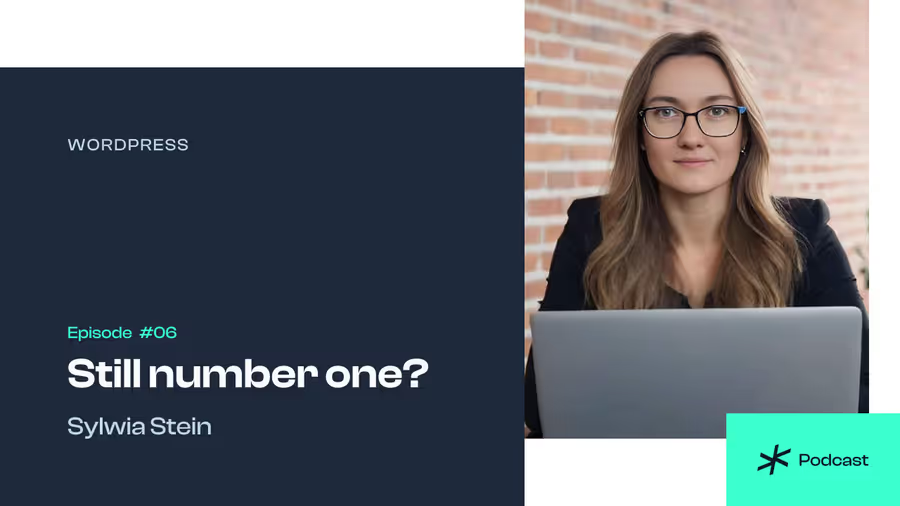
Sylwia Stein on why 43% of the web still runs on WordPress in 2026, where it breaks under its own ecosystem, and when a different CMS is the right call.
The Question Behind the 43%
WordPress still powers around 43% of the web in 2026. That number alone does not answer whether it is still the right choice for a new business — it confirms inertia, not fit. The more useful question is what kind of system WordPress has become, and where it stops working. In CMS Conf Podcast #06, Sylwia Stein — who has been working with WordPress since 2009, after passing through Joomla, Drupal, TYPO3, CMS Made Simple and several bespoke CMS builds — walks through a system-level view of WordPress today.
If you want to learn the platform from the inside instead of clicking through a tutorial stack, Sylwia runs Przystań Specek, the educational program where she teaches WordPress from both the dashboard side and the code side. Sign up at sylwiastein.pl and explore the program — it is the closest thing to working alongside someone who has shipped on every major builder generation since 2013. Try it before you commit to any CMS direction; the architectural reasoning you pick up there changes how you evaluate every alternative.
From Blog Platform to Brand Control Plane
The first architectural shift Sylwia surfaces is conceptual, not technical. WordPress did not start as a content-operations hub — it started as a blogging platform. By 2026 it has drifted into something Sylwia calls a centrum dowodzenia: a control plane for an entire brand, hosting the marketing site, the store, the blog, the community, course platforms and automations. The shift matters because most of the trade-offs people debate — performance, complexity, plugin bloat — only make sense once you accept that the system is being asked to do far more than its original scope.
That single observation reframes most of the criticism leveled at WordPress. The platform is not slow because PHP is slow. It is slow because it is being treated as a unified backend for workloads that used to live in three or four separate systems.
The Plugin Monster Is a User Failure Mode
Sylwia is direct about who breaks WordPress sites: the people running them. Her phrase — pluginowe potworki — describes the predictable outcome of stacking ten “must-have” plugins from each blog post recommendation. Performance collapses, plugins conflict, and the failure gets blamed on WordPress.
This is worth surfacing as a structural property, not a complaint. WordPress optimizes for low entry cost. The same property that lets a non-technical user launch a working store in an afternoon also lets them install incompatible plugins until the site breaks. There is no architectural fix for that without raising the entry barrier — which would erase the platform’s main advantage.
The WooCommerce Churn Statistic Is Not What It Looks Like
A LinkedIn ranking circulating recently showed WooCommerce with the steepest 6-month dropoff among e-commerce platforms. Sylwia reads it differently: low entry cost means people use WooCommerce to test whether their business idea works. When the business fails — not the technology — the store closes.
The dropoff is a feature of cheap experimentation, not a defect of the stack. Sylwia points to her own client base: a steady stream of grant-funded businesses run their store for one or two years, then close when the funding cycle ends. The platform did not fail; the business did. Reading the stat as platform failure misses the architecture entirely.
Where the Cost Curves Diverge
The trade-off against SaaS commerce platforms is a cost curve, not a feature comparison. SaaS subscriptions feel painless at 100–300 PLN per month. The pain compounds when product counts, transaction volume or feature tiers cross thresholds the vendor controls. WooCommerce inverts the curve: higher upfront effort, near-zero recurring platform fees, and changes you control rather than receive in a regulation update.
This is the kind of decision that belongs on a long-horizon spreadsheet, not on the friction of the first month. Sylwia’s grant-funded clients would have been cheaper on SaaS. Her clients building for ten-year horizons end up validating the WooCommerce calculation by year three.
Where WordPress Stops Fitting
Sylwia is unambiguous on the inverse case. WordPress stops being the right answer when the project has a real budget for bespoke work, the performance requirements are hard ceilings rather than targets, and the feature set is genuinely unusual — not “a store with three custom flows,” but workflows the plugin ecosystem cannot model without compromise.
Her phrasing is precise: zawsze trzeba iść na jakieś tam ustępstwa — you always end up making concessions. With WordPress you fit your problem to the framework’s shape. Past a certain scale and specificity, the cumulative concessions cost more than building from scratch. The break-even point is not a feature checklist — it is when the concessions outweigh the cost of bespoke engineering plus its maintenance burden.
Security Is a Discipline Problem
Security comes up briefly but lands clearly. Vulnerabilities exist in every popular CMS — Joomla, Drupal, even SaaS platforms get attacked. The differentiator is operational discipline: update cadence, abandoned plugins, password hygiene. Sylwia notes how often admin/admin still works on production WordPress sites in 2026.
WordPress’s security reputation tracks the user population’s discipline more than the codebase. That is a governance problem, not an architecture problem, and it cannot be patched by switching platforms.
If WordPress Disappeared Tomorrow
Asked the hypothetical — wake up, WordPress is gone, what now — Sylwia goes to headless. Specifically she names Ghost from earlier hands-on experience, and a generic headless CMS frontend stack as the architectural direction. The reasoning is consistent with everything else: removing the bundled, opinionated full-stack of WordPress trades ease of entry for performance and integration headroom. That is the architectural opposite of centrum dowodzenia — back to composable parts.
The 2026 Verdict
For most businesses launching online in 2026, WordPress is still the answer. Not because it is the best at any single thing, but because the cost-to-capability curve at the entry point is unmatched. The qualifier is operational: the system rewards discipline — updates, plugin restraint, performance budgets — and punishes neglect. The cases where it stops fitting are real but narrower than the discourse suggests: large bespoke projects, genuinely unusual workflows, or hard performance ceilings.
If you are evaluating WordPress against WooCommerce or against headless alternatives, the right framing is not which platform is “best.” It is which cost curve and which failure mode you would rather own.
If you want to internalize this kind of architectural reasoning rather than read about it, Sylwia’s Przystań Specek is where she teaches it directly — the dashboard view and the code view together, which is how she learned WordPress in the first place. Sign up at sylwiastein.pl and explore the program; the value is not just learning WordPress, it is learning how to evaluate any CMS against a real brief. Book a slot now, especially if you are about to make a platform decision for a client or your own business — the architectural framing pays back the moment you have to defend a choice in front of a stakeholder.
Tags
Keep Reading
SEO After the CMS Absorbed the Technical Layer
Aleksandra Kołodziejska of Top Online on GEO, the 90/10 content split, and why real experience became the strongest ranking signal for local business sites.
Spoiled for Choice: Picking a Platform for Your Online Course
Mary Czekaj on how course creators end up on the wrong platform, what that mistake actually costs, and why good enough beats perfect when choosing where to sell.
What Clients Say They Want vs What They Actually Need
Piotr Cezary Wojciechowski of Softwareness on client discovery as an architectural decision: separating stated wants from real needs before any CMS is chosen.