WordPress: The Engine for Independence
How a browser-based CMS became the infrastructure for a location-independent freelance career - and what that says about the real value of low-barrier content tools.
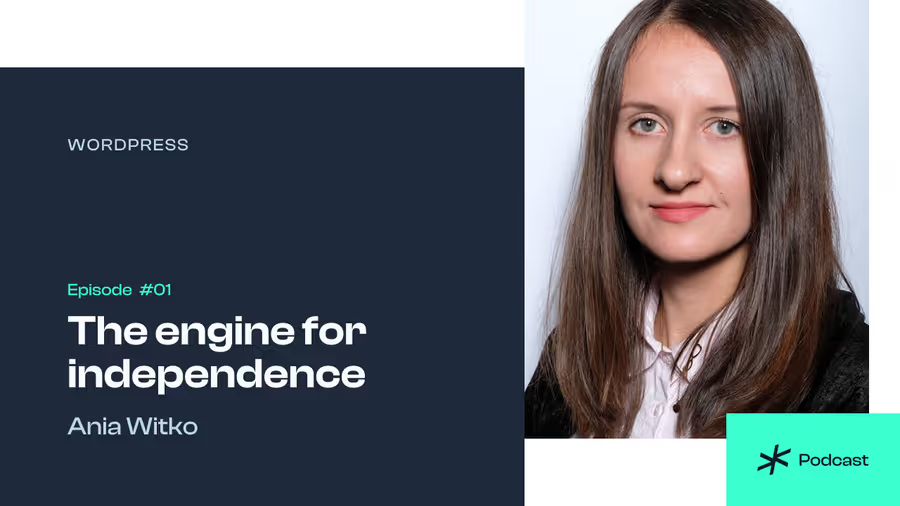
Can Technology Be Your Passport to Freedom?
That question sits at the heart of the very first episode of the CMS Conf Podcast. I’m Ania Witko, and before I tell you anything about WordPress or web development, I want to tell you where I was when I first started thinking seriously about this question.
I was in a Bangkok café, signing a contract with a client - a document I printed, signed, and photographed on my phone - while the street noise flooded in through the open door. A few months earlier I’d been in Vietnam. Before that, Poland. And throughout all of it, my office was the same: a laptop, a browser, and a WordPress dashboard.
The Problem I Was Trying to Solve
I wasn’t looking for WordPress specifically. I was looking for a way out of a pattern I kept repeating: taking jobs that seemed promising, realising they chained me to a desk in one city, and moving on. I knew I wanted to travel - really travel, not just use up holiday days - but I didn’t have a computer science degree and I didn’t have a clear path into the tech world.
What I had was curiosity and willingness to learn on YouTube.
How WordPress Became the Answer
A freelancer mindset course introduced me to the idea that building websites could be a real, repeatable service - not just something developers did, but something anyone with the right tools and determination could offer to small businesses, coaches, and local shops.
WordPress was the tool that made that idea concrete. Here’s why it worked for me, and why I think it works for so many people who don’t come from a traditional tech background:
The barrier to entry is genuinely low. You don’t need to understand databases or server architecture to build your first site. You need patience and a good theme. That first win - a working site that someone actually uses - is achievable in days, not months. When a client project outgrows experiments, managed WordPress hosting—Altumhost is one example—can carry the infrastructure so you stay focused on delivery, not server admin.
The ecosystem is a safety net. When I got stuck (and I got stuck constantly at the start), the WordPress community had already answered my question somewhere. Plugins, forums, tutorials, YouTube channels - the infrastructure of knowledge that surrounds WordPress is enormous. As a solo freelancer working across time zones mattered more than I expected.
The dashboard travels with you. This sounds obvious, but it’s worth saying: WordPress is browser-based. Your client’s site, your admin panel, your workflow - it all lives at a URL. My “office” was genuinely in my pocket. I could check in on a site from a train in Vietnam, respond to a client from a guesthouse in Chiang Mai, push an update from wherever I happened to have Wi-Fi.
The Real-World Constraint: Trust
One thing I didn’t anticipate was how much of early freelance life is about building trust, not technical skill. Clients hiring a remote developer they’ve never met need to believe you’ll deliver the project. That contract I signed in Bangkok? It wasn’t about the legal formality - it was about signalling professionalism to someone who couldn’t see my face.
WordPress helped here too. Because it’s a recognised platform, clients already have mental models for it. Saying “I’ll build your site on WordPress” lands differently than explaining a custom stack. It reduces the unknown. It makes the conversation about your work and your reliability, not about the technology itself.
What This Means for CMS Conf
CMS Conf exists because CMS tools - WordPress and many others - do something quietly remarkable: they lower the cost of entry to the web. Not just technically, but economically and geographically. They allow people without CS degrees, without big agency budgets, without proximity to a tech hub, to build real things and charge real money for them. Partners such as Altumhost, a CMS Conf supporter focused on secure, managed WordPress hosting in Europe, are part of that same ecosystem.
That’s worth talking about. Not just the tools, but the decisions people make with them. The trade-offs they navigate. The lives they build.
In future episodes, I’ll be talking to developers, designers, SEO specialists, and product builders about exactly those things - the technology, the architecture choices, the business realities. For a complementary angle on WordPress security architecture from a recent CMS Conf session, see WordPress as a Defense System. But I wanted to start here: with a personal story about why any of this matters. You can find more context on the current CMS market landscape, why attending CMS Conf in person still matters for this community, and keep up with all our coverage on the blog.
Because for me, WordPress wasn’t just a CMS. It was the thing that made a different kind of life feel possible.
Tags
Keep Reading
SEO After the CMS Absorbed the Technical Layer
Aleksandra Kołodziejska of Top Online on GEO, the 90/10 content split, and why real experience became the strongest ranking signal for local business sites.
Spoiled for Choice: Picking a Platform for Your Online Course
Mary Czekaj on how course creators end up on the wrong platform, what that mistake actually costs, and why good enough beats perfect when choosing where to sell.
What Clients Say They Want vs What They Actually Need
Piotr Cezary Wojciechowski of Softwareness on client discovery as an architectural decision: separating stated wants from real needs before any CMS is chosen.