Writing Effective Website Content: Stop Talking About Yourself
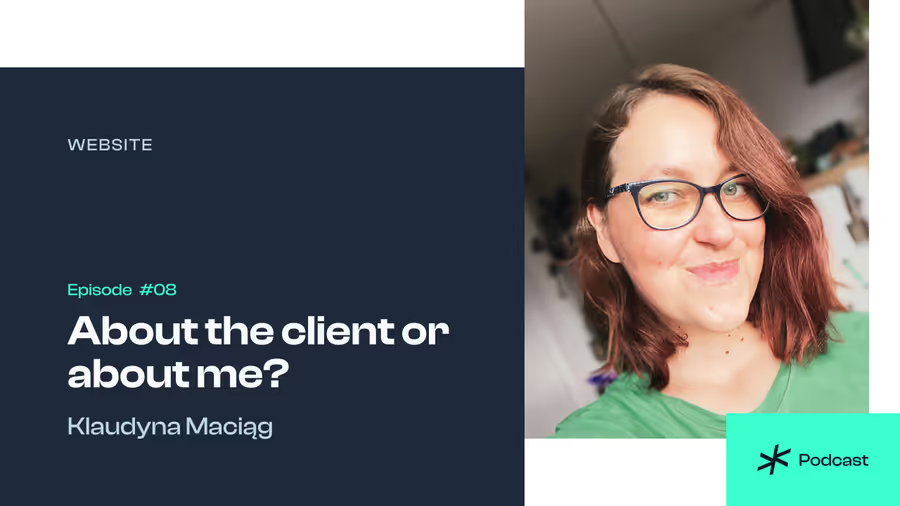
Klaudyna Maciąg explains why most CMS websites fail at content — they describe the company instead of the reader — and how to fix it without a redesign.
The Real Problem with Most Website Copy
Open almost any small or mid-sized company website and you will find the same pattern: a hero section that announces how many years the business has existed, a homepage that catalogues services in feature lists, an About page that lists awards, and a navigation that leads nowhere in particular. The website is technically present, but it does not do anything for the person reading it. Klaudyna Maciąg, who has been making a living with words for over twenty years and now runs the writing channel Let’s Start with the Word, frames the most common content failure as a structural one: the page talks about the company instead of the person on the other side of the screen.
If you write your own website copy — or you are getting ready to brief someone who will — Klaudyna’s PPD method (Write. Publish. Act.) is a practical framework worth checking. It is built for people who want to publish without chasing reach metrics, and it walks through the exact preparation work most owners skip before they start writing. Her YouTube channel Let’s Start with the Word covers the same ground in shorter pieces, and her writing on grajmerki.pl shows how the same principles apply outside the marketing context entirely.
What “Effective Content” Actually Means
The word “effective” gets used so loosely that it stops meaning anything. Klaudyna’s working definition is narrow on purpose: content is effective when it has a defined goal and that goal is achieved. Not creative goals, not emotional goals — measurable ones. A piece of content might exist to drive a sale, increase reach, build awareness, or spark a discussion. Each of those produces a different artifact and a different metric. A Facebook post with a link tells you click-through. A LinkedIn post tells you engagement. A landing page tells you conversion. If you cannot name the goal of a page before you write it, you cannot tell whether the page is working once it ships.
This is where most CMS-built sites quietly fail. The CMS imposes no constraint on what gets added — sections, tabs, blog categories, contact forms, lead magnets — so teams add everything and assign no goal to any of it. The result is a website that looks busy and converts nothing.
Don’t Start with the Persona
Most marketing advice tells you to start with a persona: build a demographic portrait, name your ideal client, list their age and city and hobbies, and write to that fictional person. Klaudyna recommends the opposite. Start with yourself.
The reason is practical. If you build a persona before you have established your own voice, format preferences, and tone, you end up trying to mimic someone else’s communication style on platforms you do not actually use. You will hate the work, you will not stay consistent, and the audience will sense the strain. Begin with what you genuinely enjoy creating — written posts, video, audio, long-form essays, short reels — and which platforms you already use as a reader. Only then do you meet the audience halfway, in the places where you can sustain showing up.
The audience you eventually identify may not be defined by demographics at all. Klaudyna gives the example of her Serbian language class: people of different ages, different countries, different professions, connected only by a shared interest. Your audience can be a niche of interest rather than a segment of a population — and that recognition changes how you write.
Tone of Voice as a Site-Wide Decision
Most websites read like they were written by three different people on three different days. The About page is stiff and formal, the blog is casual and slangy, the product descriptions are dry technical specs. Each section was written by a different freelancer with a different style, and no one sat down to define the brand’s voice up front.
Tone of voice is not a marketing flourish — it is a reusable decision that makes every subsequent piece of writing faster and more consistent. Decide whether the brand is formal or casual, whether it uses gender-inclusive language, whether it addresses readers directly or in third person. Write those rules down as a short document. Hand the document to anyone you delegate writing to. The result is a site that sounds like one company instead of a committee.
Every Page Needs an Exit
A common structural failure is the dead-end page. Someone lands on the About page, reads it, and finds nothing pointing them anywhere else — no link to a case study, no link to a relevant offer, no link to a blog post that goes deeper. The browser tab closes. Klaudyna’s rule is simple: every subpage links to another subpage, every blog post links to another blog post or to a category or to a relevant product, and every page has a clear next step for the reader.
This is the same internal-linking principle that powers SEO, but the reason it matters here is not search ranking — it is that a website is a navigation system, not a folder of static documents. A reader who reaches a dead end leaves. A reader who is offered a meaningful next click stays. The cost of building this network is low; the cost of not building it is everyone who visits your site once and never returns.
Long-Distance Content Beats Disposable Content
Klaudyna draws a useful distinction between content that lives for twenty-four hours and content that lives for years. An Instagram post is disposable by design — the platform’s discovery model favours recency, search is weak, and links between posts are nearly impossible. A blog post on your own website, a podcast episode, or a YouTube video behaves differently: it stays indexed, it surfaces in search, it links to and from related content, and it can drive sales months or years after publication.
For website owners, this is the argument for investing in content that lives on infrastructure you control. Klaudyna mentions sales coming in from YouTube videos she recorded a year ago — not because she is actively promoting them, but because the platform’s search and recommendation engine keeps surfacing them to people who need them. A CMS-driven blog with proper internal linking and SEO does the same. The work compounds.
The Hero Section Test
If you can do only one thing this week, Klaudyna recommends opening your own website on both phone and laptop and looking at the hero section — the first thing a visitor sees. Three questions:
- Within five seconds, can a stranger figure out what you do?
- Within five seconds, can they figure out what they will get from this site?
- Is there a clear next action — a link, a button, a question that pulls them deeper?
Most hero sections fail at least one of these. There is a giant logo that means nothing to a first-time visitor, or a slow-loading photo, or a slogan that sounds clever but says nothing about the offering. The visitor does not stay long enough to scroll. Fixing the hero section costs nothing — no developer, no redesign — but it changes how every piece of marketing that drives traffic to the page performs.
Working with Copywriters
A recurring theme in the conversation is the relationship between business owners and the copywriters they hire. Klaudyna’s diagnostic for a good copywriter is whether they ask questions. A copywriter who takes your brief at face value and writes nothing back is going to invent everything from thin air, and the copy will read like it. A good copywriter sends a structured brief — questions about your audience, your tone, your story, your goals — and expects detailed answers. Filling that brief is not optional homework; it is the only way to get content that sounds like your business and not like a generic template.
The corollary is that AI tools have not replaced this work. They have eliminated the cheapest end of the market — the filler SEO text that nobody read anyway — and they have made first drafts faster for people who do not enjoy writing. But they cannot produce a brand voice that does not exist yet, and they cannot know your specific clients, your specific objections, the specific anecdotes that make your story yours. AI is a sounding board for ideation and a draft accelerator. It is not a content strategy.
Where to Start
If you have a CMS website that is not converting, Klaudyna’s framework gives you a sequence: define the goal of each page, audit the hero section, write down your tone of voice, link every page to a meaningful next page, and invest in content that outlives a single news cycle. None of this requires a redesign. All of it requires the preparation work most owners skip.
For the deeper version of this — including the writing process itself — Klaudyna’s PPD method (Write. Publish. Act.) is the structured walkthrough. It is built for owners and creators who want a system they can apply without becoming full-time content marketers, and it pairs naturally with the structural advice in this episode. Her YouTube channel Let’s Start with the Word covers individual topics in shorter form, and her writing at grajmerki.pl is worth a look if you want to see the same voice principles applied outside the small-business context. The fastest way in is to pick one — the channel for video, the method for the full system — and start applying it to the page that hurts the most on your own site this week.
Tags
Keep Reading
SEO After the CMS Absorbed the Technical Layer
Aleksandra Kołodziejska of Top Online on GEO, the 90/10 content split, and why real experience became the strongest ranking signal for local business sites.
Spoiled for Choice: Picking a Platform for Your Online Course
Mary Czekaj on how course creators end up on the wrong platform, what that mistake actually costs, and why good enough beats perfect when choosing where to sell.
What Clients Say They Want vs What They Actually Need
Piotr Cezary Wojciechowski of Softwareness on client discovery as an architectural decision: separating stated wants from real needs before any CMS is chosen.